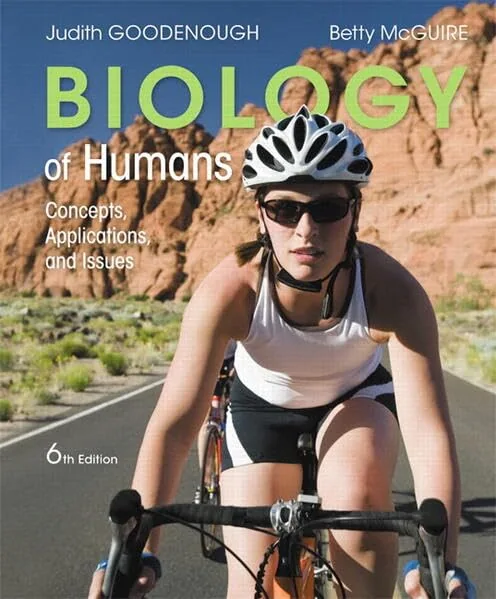
Biology of Humans: Concepts, Applications, and Issues, 6th Edition
By Judith Goodenough, Betty McGuire
About this ebook
Biology of Humans: Concepts, Applications, and Issues, 6th Edition introduces human biology through body systems, genetics, health topics, and environmental relationships. Judith Goodenough and Betty McGuire connect biological concepts with issues such as nutrition, disease, and reproductive health. Introductory students also encounter questions about evaluating health claims and scientific evidence.
Inside this title
Human body systems connected with everyday health applications
Current listed price $34.99Regular price $91.00Digital ebook
Goodenough and McGuire link the organization of the human body with biological questions that arise in everyday life. Their account covers major organ systems, DNA and inheritance, evolution, and ecological relationships. Health topics such as nutrition, exercise, stress, and common diseases provide contexts for applying those concepts.
Special Topic chapters examine issues including infectious disease, cancer, and reproductive health. The sixth edition emphasizes critical thinking about information from media and other sources, inviting readers to consider the evidence behind claims. Students in introductory human biology courses can study both the mechanisms of body function and the relationship between human biology, health, and the environment.
Study guide included
Inside Biology of Humans: Concepts, Applications, and Issues, 6th Edition.
This text treats the human body as a set of linked systems and asks readers to carry each explanation across levels, from a molecule to a tissue to a symptom. Health topics such as cancer, diabetes, infection, and environmental exposure become occasions to practice judging evidence rather than memorizing conclusions.
Early chapters establish the chemistry, cell structure, and feedback logic that the rest of the book depends on. Movement follows, covering bone, muscle, neurons, senses, and hormones, with glucose control as a recurring example of endocrine feedback. Maintenance occupies the middle: circulation, gas exchange, digestion, kidney function, and two layers of immunity. Reproduction and development come next, then inheritance, gene technology, and cancer. The final chapters place humans in evolutionary and ecological context, asking how populations, resources, and pollutants connect personal health to larger systems.
Cells, membranes, and steady conditions
Water's polarity explains why certain substances dissolve and others do not, and the membrane exploits that split to control traffic. Organelles divide labor, tissues combine into organs, and organs cooperate in systems. Homeostasis is presented as feedback: sensors notice a deviation and effectors push back. The exercise and sweating example shows why the same response can succeed or fail depending on humidity, which is a useful reminder that context belongs in any physiological claim.
Name the variable being regulated
Check whether the response opposes change
Account for environmental conditions
Chs. 2–4
Frames, senses, nerves, and hormones
Bones provide support and rebuild under load; joints define which motions are possible; muscles generate force by sliding filaments. The nervous system carries rapid electrical messages, while the endocrine system sends slower chemical ones through blood. Receptors convert light, force, and chemicals into signals. Comparing the two communication routes, and seeing where they overlap in glucose regulation, gives readers a template for deciding which system explains a given response.
Match tissue layout to movement
Contrast fast and slow signaling
Find where systems overlap
Chs. 5–10
Transport, exchange, waste, and defense
Heart, vessels, lungs, gut, and kidneys form one continuous logistics problem, and the book follows materials rather than organs in isolation. Hemoglobin carries oxygen, digestion produces absorbable molecules, and nephrons adjust filtrate to manage water and solutes. Immunity is split into fast innate reactions and slower adaptive ones that remember past encounters. Carbon monoxide poisoning appears as a case that only makes sense when airflow, blood, and circulation are considered together.
Follow the material, not the organ
Separate innate from adaptive defense
Explain a case across systems
Chs. 11–16
Reproduction, pregnancy, and the lifespan
Testes and ovaries release gametes along with hormones, and coordinated signals prepare the reproductive tract. Once fertilization occurs, cells divide, migrate, and specialize as organs take shape, while the placenta mediates exchange between the parent and the fetus. Timing matters: a single exposure can carry different consequences depending on which structures are forming. Growth and maturation continue after delivery, and subjects like sexually transmitted disease and autism show why precise categories and careful evidence matter.
Place events on a developmental clock
Describe what the placenta moves
Define terms before arguing
Chs. 17–18
Inheritance, gene tools, and cancer
Mitosis preserves chromosome number while tissues grow and mend, whereas meiosis halves it and reshuffles combinations for gametes. Segregation patterns permit prediction, but nondisjunction and other chromosome-level events demand attention to chromosome movement during division. Gene expression is distinct from sequence, a point that becomes concrete when biotechnology compares DNA and when cancer is explained as accumulated alterations in growth regulation within a tissue lineage rather than an inherited family trait.
Separate inherited variants from local mutations
Track chromosomes through division
Ask which genes a cell uses
Chs. 19–21
Ancestry, populations, and shared environments
Fossils, comparative anatomy, and molecular data each contribute different detail to the human family tree, and the book treats agreement among them as the strongest kind of support. Human variation today reflects inherited diversity plus environment, and short-term adjustment is carefully distinguished from evolutionary change. The closing material follows energy through food webs, matter through cycles, and pollutants through neighborhoods, linking population-level patterns to individual exposure.
Weigh three lines of ancestry evidence
Distinguish acclimation from evolution
Link exposure to a mechanism
Chs. 22–24
Chapter and section map
Body Organization and Homeostasisp. 65
Neurons: The Matter of the Mindp. 115
The Cardiovascular and Lymphatic Systemsp. 213
Body Defense Mechanismsp. 239
Development throughout Lifep. 366
Chromosomes and Cell Divisionp. 394
DNA and Biotechnologyp. 436
Ecology, the Environment, and Usp. 491
Key takeaways
Follow any health claim from molecule to tissue to system to outcome, and name each link.
For feedback, identify the controlled variable first, then check whether the response truly opposes the deviation.
A plausible mechanism explains how; observations establish whether — a serious claim needs both.
Students in non-major or introductory human biology courses, allied health trainees, and general readers who want a systems-level account of the body tied to current health and environmental questions.
Topics covered
human biology
body systems
homeostatic regulation
nutrition and health
genetics and inheritance
cancer biology
immune defense
environmental health
Questions about this ebook.
Edition, audience, and study-guide details at a glance.
What is Biology of Humans: Concepts, Applications, and Issues, 6th Edition about?
Biology of Humans: Concepts, Applications, and Issues, 6th Edition introduces human biology through body systems, genetics, health topics, and environmental relationships. Judith Goodenough and Betty McGuire connect biological concepts with issues such as nutrition, disease, and reproductive health. Introductory students also encounter questions about evaluating health claims and scientific evidence.
Which edition of Biology of Humans: Concepts, Applications, and Issues, 6th Edition is this?
This listing is for the 6th edition. Check the title, ISBN, and book details above before ordering, especially if your course or reading list names a specific edition.
Who is Biology of Humans: Concepts, Applications, and Issues, 6th Edition for?
Students in non-major or introductory human biology courses, allied health trainees, and general readers who want a systems-level account of the body tied to current health and environmental questions.
Does this page include a study guide?
Yes. This page includes an original study guide with six thematic sections, key takeaways, and a chapter and section map for structured reading.