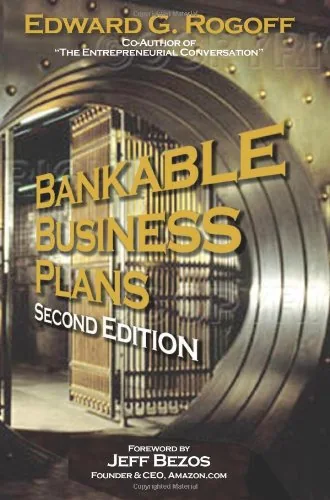
Cover of Bankable Business Plans, Second Edition

Bankable Business Plans, Second Edition

By Edward G. Rogoff

About this ebook

Bankable Business Plans, Second Edition explains how to develop a business proposal around the questions lenders and investors ask. Edward G. Rogoff guides entrepreneurs, small business owners, and business students through market analysis, financial projections, management capability, and risk, with examples and worksheets supporting the planning process.

Inside this title
  • Financial projections linking income, cash flow, and balance sheets
Current listed price $5.99Regular price $12.00Digital ebook
Buy now

Digital ebook. Checkout sends an order request.

Format
Digital ebook
ISBN
9780979152238
Last updated
2026-11-03

What this book covers.

A proposal needs to connect a business idea with evidence about customers, operations, and finances. Rogoff examines those connections from the perspective of the people evaluating a funding request, distinguishing the concerns of commercial lenders, angel investors, and venture capitalists.

The book works through executive summaries, market research, management profiles, income statements, cash flow forecasts, and balance sheets. Examples and worksheets help readers organize information and examine assumptions as they assemble a plan. Entrepreneurs preparing a first proposal, owners planning expansion, and students studying enterprise development can use this second edition to understand the relationship between a business narrative and its supporting financial case.

Study guide included

Inside Bankable Business Plans, Second Edition.

A business plan is a document written for a reader who can say no. This guide follows Rogoff's approach to that reader, connecting market evidence, management credibility, financial statements, risk, and the executive summary, and distinguishing what commercial lenders look for from what angel investors and venture capitalists expect.

Rogoff writes for the entrepreneur who must persuade a funder, and the book's structure follows the questions that funders ask. Market analysis establishes that customers exist; management profiles establish that someone can deliver; financial statements establish that the numbers cohere. Income, cash flow, and balance sheet projections are treated as connected views of one business rather than separate exercises. Risk and assumptions receive attention because projections rest on them. The executive summary ties the narrative together, and the discussion distinguishes the priorities of commercial lenders from those of angel investors and venture capitalists.

Writing for the funder's questions

Rogoff frames planning as an exercise in answering someone else's questions. A funder wants to know whether the idea is viable, who will run it, and how the money returns. Writing for that reader changes what belongs in the plan and how much explanation each section needs.

  • The plan answers a reader's concerns
  • Viability, capability, and return are central
  • Audience shapes structure and emphasis
Topic 1

Market analysis and customer evidence

Market analysis is the evidence that customers exist and that the business can reach them. The text connects claims about demand with research and reasoning, treating the section as an argument to be supported rather than an assertion of enthusiasm. The reader is asked to show the basis for the numbers.

  • Demand claims need support
  • Customer evidence grounds the argument
  • Market reach is part of viability
Topic 3

Management capability

A plan must show that someone can deliver what it promises. Management profiles connect experience and responsibilities to the operation described, and the text treats credibility here as part of the proposal's evidence. The question is not credentials alone but fit between people and tasks.

  • Profiles link people to responsibilities
  • Credibility is part of the evidence
  • Fit matters more than titles alone
Topic 4

Income, cash flow, and balance sheet

Income, cash flow, and balance sheet projections are presented as related statements describing one business. The income statement shows performance over a period, cash flow shows timing, and the balance sheet shows position at a point. Reading them together reveals assumptions that any one alone would hide.

  • The income statement shows performance over time
  • Cash flow reveals timing
  • The balance sheet shows position at a date
Topics 5-7

Risk and stated assumptions

Projections rest on assumptions, and the plan is stronger when those assumptions are stated and examined. The text discusses risk in terms of what could differ from expectation and how the business would respond. This section asks the writer to be candid rather than merely optimistic.

  • Projections depend on assumptions
  • Risk concerns deviation from expectation
  • Candour strengthens the proposal
Topic 8

The executive summary and different audiences

The executive summary compresses the argument into a narrative a reader can follow quickly. The book also distinguishes lenders from equity investors, since repayment and ownership create different concerns. The same facts may need different emphasis depending on who is being asked to commit.

  • The summary carries the whole argument briefly
  • Lenders and investors weigh different risks
  • Emphasis changes with the funder
Topics 2, 8

Topic map

  • Writing for the funding readerTopic 1
  • Executive summary and business narrativeTopic 2
  • Market analysis and customersTopic 3
  • Management profiles and capabilityTopic 4
  • Income statement projectionsTopic 5
  • Cash flow forecastsTopic 6
  • Balance sheets and financial positionTopic 7
  • Risk, assumptions, and funder prioritiesTopic 8

Key takeaways

  • Funder questions should shape the plan's structure, not just its tone.
  • Financial statements must be read together to expose the assumptions behind them.
  • Lenders and equity investors want different things from the same business.

First-time entrepreneurs, small business owners planning expansion, and business students who need to understand how a proposal is evaluated by funders.

Topics covered

  • business plan writing
  • bankable business plan
  • market analysis
  • financial projections
  • cash flow forecast
  • balance sheet
  • risk assessment
  • startup funding

Questions about this ebook.

Edition, audience, and study-guide details at a glance.

What is Bankable Business Plans, Second Edition about?

Bankable Business Plans, Second Edition explains how to develop a business proposal around the questions lenders and investors ask. Edward G. Rogoff guides entrepreneurs, small business owners, and business students through market analysis, financial projections, management capability, and risk, with examples and worksheets supporting the planning process.

Which edition of Bankable Business Plans, Second Edition is this?

This listing is for the 2nd edition. Check the title, ISBN, and book details above before ordering, especially if your course or reading list names a specific edition.

Who is Bankable Business Plans, Second Edition for?

First-time entrepreneurs, small business owners planning expansion, and business students who need to understand how a proposal is evaluated by funders.

Does this page include a study guide?

Yes. This page includes an original study guide with six thematic sections, key takeaways, and a topic map for structured reading.

Keep your curiosity going.

More books with overlapping topics.

Browse all ebooks

Enter your name and email to open a WhatsApp message with your details.