

Curated reading setExplore this set
Art History & Archaeology
Trace art history from major artists and global art movements to ancient Greek art and archaeology with three accessible ebooks.
$47.68$52.98
10% less than current individual prices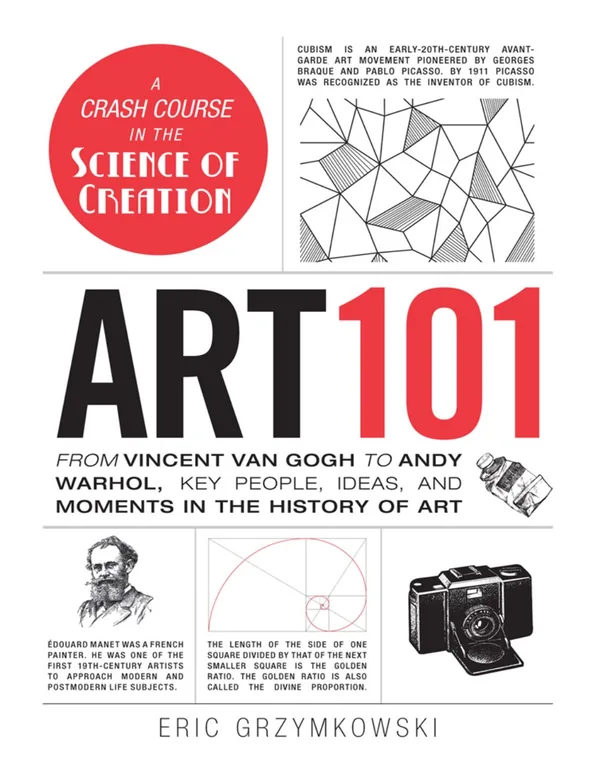
Art 101 introduces Western art history through artists, movements, techniques, and cultural context. Eric Grzymkowski explains subjects ranging from Renaissance perspective to Impressionism, Cubism, and Pop Art in short, accessible sections. The book suits museum visitors, beginning students, and general readers building a vocabulary for discussing and interpreting visual art.
Digital ebook. Checkout sends an order request.
Trace art history from major artists and global art movements to ancient Greek art and archaeology with three accessible ebooks.
Artists' stories provide entry points into the ideas and techniques associated with different periods of art. Grzymkowski introduces figures such as Van Gogh, Warhol, Michelangelo, and Frida Kahlo while considering the cultural settings in which they worked. Movements including the Renaissance, Baroque, Impressionism, and Cubism supply a broader historical framework.
Discussions of composition, symbolism, color, and perspective help readers examine what they see in an artwork. Painting media and techniques sit alongside the effects of photography and digital forms on artistic practice. The compact sections support browsing or short reading sessions, making the book useful for readers seeking an introductory companion to gallery visits or further study.
Art history becomes approachable when it is told through the people who made the work. Eric Grzymkowski moves from Michelangelo to Warhol, using artists and movements to introduce the vocabulary of composition, colour, and perspective that lets a viewer say what is actually happening in a picture.
The book treats Western art as a sequence of people, ideas, and moments rather than a list of dates. Short sections introduce figures such as Van Gogh, Warhol, Michelangelo, and Frida Kahlo while placing them in the cultural settings that shaped their work. Movements from the Renaissance through Baroque, Impressionism, Cubism, and Pop Art supply the historical frame. Alongside the narrative, readers meet the practical language of art: composition, colour, symbolism, and perspective, together with painting materials and techniques. Photography and digital forms appear as forces that changed what artists could do. The compact format suits browsing, gallery visits, and first courses alike.
Individual artists carry much of the book's narrative. A painter's choices and circumstances give a reader a way into a period that a list of movement names cannot supply. By beginning with people rather than abstractions, the text makes historical change feel like something made by particular hands, and it gives beginners a memorable handle for later detail.
The Renaissance, Baroque, Impressionism, Cubism, and Pop Art are used as landmarks that organise the story. Each movement is treated as a response to what came before, so style becomes intelligible as a set of choices rather than a label to memorise. The sequence gives readers a map they can carry into a gallery or a classroom survey.
Composition and perspective are introduced as tools for looking. The book explains how arrangement directs attention and how perspective constructs space on a flat surface, then uses those ideas to help readers describe what they see. This vocabulary turns an initial reaction into an observation that can be explained and compared with another viewer's account.
Colour and symbolism are presented as carriers of meaning rather than decoration. Readers are shown how hue, contrast, and chosen objects can shape the mood of a work and guide interpretation. Because these elements are discussed in plain terms, the book gives beginners a way to move from liking or disliking an image toward explaining what in the image produced that response.
The book looks at the media and methods behind the images, including the properties of paint and the working choices they allow. Technique is connected to effect: what a surface looks like depends partly on how it was made. This attention to craft gives readers a more grounded sense of why works from different periods look the way they do.
Photography and digital forms are treated as developments that altered the conditions of art-making. When a machine could capture an image, painting's relationship to representation changed, and later digital tools reshaped what could be produced and distributed. The book uses these shifts to show that art history is a moving situation rather than a closed catalogue.
Museum visitors, beginning art students, and general readers who want an accessible vocabulary for looking at Western art and placing artists within their historical movements.
Edition, audience, and study-guide details at a glance.
Art 101 introduces Western art history through artists, movements, techniques, and cultural context. Eric Grzymkowski explains subjects ranging from Renaissance perspective to Impressionism, Cubism, and Pop Art in short, accessible sections. The book suits museum visitors, beginning students, and general readers building a vocabulary for discussing and interpreting visual art.
Museum visitors, beginning art students, and general readers who want an accessible vocabulary for looking at Western art and placing artists within their historical movements.
Yes. This page includes an original study guide with six thematic sections, key takeaways, and a topic map for structured reading.
More books from this carefully grouped reading set.