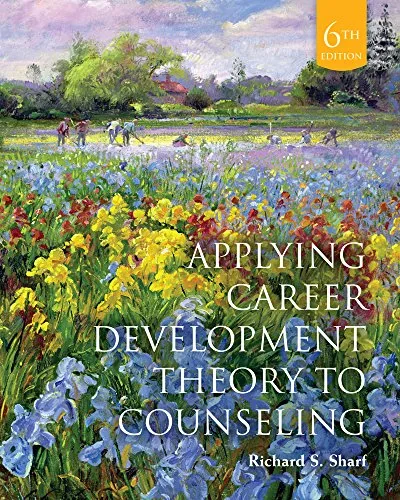
Applying Career Development Theory to Counseling, 6th Edition
By Richard S. Sharf
About this ebook
Applying Career Development Theory to Counseling, 6th Edition translates major career theories into counseling assessment and intervention. Richard S. Sharf examines vocational interests, life stages, self-efficacy, learning experiences, and social constraints. Case examples connect these perspectives with client needs, making the book useful for counseling students and career development practitioners.
Inside this title
Holland, Super, and social cognitive approaches to career development
Current listed price $36.99Regular price $89.00Digital ebook
Sharf presents career development through several theoretical lenses, including Holland's vocational personalities, Super's life-span approach, social cognitive career theory, and the work of Gottfredson and Krumboltz. Each perspective offers a different way to understand aspirations, decisions, and transitions, allowing readers to compare explanations rather than rely on a single model.
Case material and application guidance link these theories to assessment, intervention selection, and the interpretation of career interests. Ethical and multicultural considerations address the influence of context on both aspirations and counseling practice. The text can support graduate training or professional study for counselors working with educational choices, occupational exploration, and changing career circumstances.
Study guide included
Inside Applying Career Development Theory to Counseling, 6th Edition.
Sharf takes the major career theories and asks what each one lets a counsellor see in a client's choices. Rather than defending a single model, the book places them side by side and shows how their differences change assessment and intervention.
The sixth edition surveys career development through several lenses. Holland's vocational personalities, Super's life-span account, social cognitive career theory, and the contributions of Gottfredson and Krumboltz each offer a different explanation of aspiration, decision, and transition. Presenting them together lets readers compare assumptions instead of adopting one framework wholesale. Case material then ties theory to assessment and to the selection of interventions, showing how an interpretation of interests becomes a counselling move. Ethical and multicultural considerations keep context in view, since opportunity and constraint shape careers as much as preference does. The text is built for graduate training and for practitioners rethinking how they work with educational and occupational choices.
Theory as a set of lenses
No single framework is presented as the answer. The book treats each theory as a lens that highlights some features of a career and leaves others in shadow. Comparison becomes the method: a counsellor who knows several accounts can notice when a client's situation fits one better than another.
Each theory highlights different features
Comparison is the working method
Fit depends on the client's situation
Topic 1
Holland and vocational personality
Holland's approach organises interests into types and asks how well a person's pattern matches an environment. The book explains the logic of that match and what it implies for exploration and choice. The model's appeal lies in its clarity, and its limits appear where work and identity refuse to sort neatly.
Interests sort into recognisable types
Match links person and environment
Clarity comes with limits
Topic 2
Super and the life span
Super places career within a sequence of stages and roles that shift over time. The text shows how aspirations are revised as circumstances and self-conceptions change, which reframes a decision as one moment in a longer arc. This view makes room for late starts, re-entries, and transitions that a static model would miss.
Careers unfold across stages
Self-conception changes with time
Transitions are normal, not failures
Topic 3
Social cognitive and learning accounts
Social cognitive career theory and Krumboltz's learning approach explain choice through self-efficacy, expectations, and accumulated experience. The book shows how confidence and opportunity interact, and why two people with similar interests may pursue different paths. Learning experiences become something a counsellor can examine and, at times, help revise.
Self-efficacy shapes what is attempted
Learning experiences accumulate over time
Opportunity and confidence interact
Topic 4-5
Assessment and case application
Theory earns its keep when it changes what a counsellor does. The text connects interpretations of interest inventories to intervention choices and to the questions asked in session. Cases show the reasoning in motion, including the point where a model's explanation stops fitting the client and another is needed.
Assessment serves intervention planning
Interpretation guides the question asked
Cases expose where models fail
Topic 6-7
Context, ethics, and culture
Careers are shaped by constraints as well as preferences. Ethical and multicultural considerations keep the counsellor alert to how background, opportunity, and discrimination affect both aspiration and advice. The book treats context as part of the theory rather than an afterthought, which changes what counts as a good career decision.
Constraints shape career aspiration
Culture belongs inside the analysis
Ethics informs career interpretation
Topic 8
Topic map
Career Development FrameworksTopic 1
Holland's Vocational TypesTopic 2
Super's Life-Span ApproachTopic 3
Social Cognitive Career TheoryTopic 4
Gottfredson and KrumboltzTopic 5
Assessment and InterpretationTopic 6
Intervention PlanningTopic 7
Ethics and Multicultural PracticeTopic 8
Key takeaways
Knowing several theories lets a counsellor notice which one actually fits the client in front of them.
A career decision is easier to understand as a moment in a longer sequence of roles and revisions.
Context and constraint belong in the analysis, not in a footnote about diversity.
Graduate counselling students, career development practitioners, and counsellors who work with educational choices, occupational exploration, and mid-career transitions in a range of clinical and community settings.
Topics covered
career development
career counselling
Holland codes
Super life span
social cognitive career theory
vocational assessment
Questions about this ebook.
Edition, audience, and study-guide details at a glance.
What is Applying Career Development Theory to Counseling, 6th Edition about?
Applying Career Development Theory to Counseling, 6th Edition translates major career theories into counseling assessment and intervention. Richard S. Sharf examines vocational interests, life stages, self-efficacy, learning experiences, and social constraints. Case examples connect these perspectives with client needs, making the book useful for counseling students and career development practitioners.
Which edition of Applying Career Development Theory to Counseling, 6th Edition is this?
This listing is for the 6th edition. Check the title, ISBN, and book details above before ordering, especially if your course or reading list names a specific edition.
Who is Applying Career Development Theory to Counseling, 6th Edition for?
Graduate counselling students, career development practitioners, and counsellors who work with educational choices, occupational exploration, and mid-career transitions in a range of clinical and community settings.
Does this page include a study guide?
Yes. This page includes an original study guide with six thematic sections, key takeaways, and a topic map for structured reading.