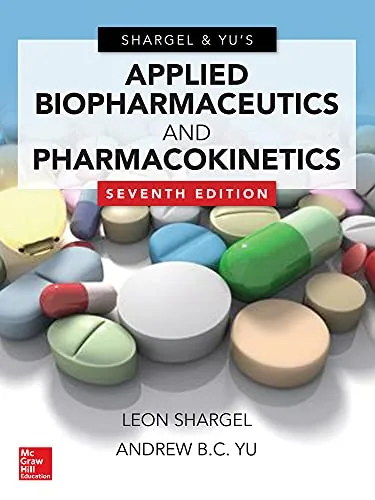
Applied Biopharmaceutics & Pharmacokinetics, 7th Edition examines drug movement through the body and the influence of dosage forms on drug availability. Leon Shargel and Andrew B. C. Yu cover absorption, distribution, metabolism, excretion, modeling, and bioequivalence. Pharmacy students and practitioners can connect quantitative methods with questions about dosing and drug exposure.
Inside this title
Drug absorption, distribution, metabolism, and excretion as linked processes
Current listed price $24.00Regular price $52.00Digital ebook
Drug concentrations reflect the combined effects of absorption, distribution, metabolism, and excretion. Shargel and Yu explain these processes through compartmental and noncompartmental models, clearance concepts, protein binding, and factors affecting the rate and extent of absorption. Quantitative reasoning links the underlying science with the interpretation of drug exposure.
The seventh edition also examines bioavailability, bioequivalence study design, dosage regimen development, and therapeutic drug monitoring. Discussion of loading and maintenance doses and special populations illustrates applications of pharmacokinetic principles. Pharmacy learners and practitioners reviewing the subject can use this coverage to study the relationship between formulation, measured concentrations, and the scientific basis of dosing decisions.
A quantitative introduction to how dosage forms release drug and how the body absorbs, distributes, metabolizes and eliminates it. Shargel and Yu connect models and product comparisons to practical questions about exposure, dosing and bioequivalence, for pharmacy students and practitioners who work with drug delivery data.
Opening chapters build the quantitative record: dose, route, sampling times, units, rates and orders. The middle chapters apply one- and multi-compartment models to intravenous and oral input, repeated dosing and nonlinear behavior, then examine distribution, metabolism and clearance. Later material turns to dissolution, formulation, bioavailability and bioequivalence, and finally to the relationship between concentration and response, always asking whether the model's assumptions fit the question being asked. Worked problems and datasets let readers practice choosing a model, checking its assumptions and stating what the evidence supports.
From product to measured exposure
Biopharmaceutics asks how drug substance, dosage form and route affect delivery, while pharmacokinetics describes concentration over time as the body absorbs, distributes, metabolizes and eliminates drug. Pharmacodynamics links exposure to response. A slow tablet and a delayed effect are therefore different questions requiring different measurements. Before graphing or fitting, record dose, route, sampling times and consistent concentration units, because a unit mismatch makes raw values misleading.
Separate product behavior from body handling
Pharmacodynamics links exposure to effect
Fix units before plotting concentrations
Interpret fits against data quality
Chs. 1–3 · pp. 1, 27, 51
Compartments and intravenous input
After a rapid intravenous dose, a one-compartment model treats measured concentration as representative of an apparent space, and first-order elimination makes the logarithm fall linearly. An early rapid decline followed by a slower terminal phase may justify a multicompartment description, and apparent compartments need not map to organs. A bolus is modeled as immediate input, while an infusion supplies drug over time, so concentration approaches a plateau and declines after stopping.
One-compartment models assume a representative space
Multicompartment fits early and terminal phases
Apparent compartments are not organs
Infusion plateaus reflect input and removal
Chs. 4–6 · pp. 75, 97, 131
Clearance, distribution and repeated dosing
Clearance relates measured concentration to the rate of elimination, and apparent volume of distribution relates amount in the body to concentration; half-life can reflect both under a linear model. Renal and hepatic elimination, protein binding and metabolic variation explain why these quantities differ across people and conditions. When linear kinetics hold, single-dose profiles can be superimposed, but saturable processes make exposure rise disproportionately with dose.
Clearance links concentration to elimination rate
Half-life can reflect volume and clearance
Superposition requires linear kinetics
Saturable pathways break dose proportionality
Chs. 7–13 · pp. 149–357
Oral absorption and product design
An oral product must release drug before absorption can occur, so dissolution, permeability, gastrointestinal conditions and presystemic metabolism each shape the measured profile. Peak concentration and time to peak describe curve shape, while total exposure also reflects clearance. In vitro dissolution tests distinguish formulations under defined conditions, but their biological meaning depends on the product and the drug's absorption characteristics.
Release must precede absorption
Dissolution and permeability shape the curve
Peak and timing differ from total exposure
In vitro differences need in vivo evidence
Chs. 8 and 14–15 · pp. 177, 373, 415
Bioavailability and formulation comparison
Pharmaceutical equivalence concerns the products themselves, bioavailability concerns how fast and how completely drug becomes available, and bioequivalence compares exposure under a suitable design. Area under the curve and peak concentration carry different interpretations, and study variability, sampling and the reference product all matter. Modified-release products deliberately alter timing, and delivery devices or biotechnology-derived products add further properties that affect comparison.
Equivalence, bioavailability and bioequivalence differ
AUC and peak answer different questions
Design and reference product affect comparison
Modified release deliberately changes timing
Chs. 16–20 · pp. 469–615
Relating exposure to response
Measured plasma concentration can change before an effect appears, because distribution to the site of action, indirect physiological responses or tolerance intervene. Concentration and response should be paired at meaningful times and read as a pattern rather than assuming peak effect matches peak concentration. A measured value reflects regimen, adherence, sampling time and individual handling, so a sample taken during distribution differs from a later one.
Effect may lag measured concentration
Pair concentration with timed response data
Interpret monitoring against regimen and timing
Distribution-phase samples differ from later ones
Chs. 21–22 · pp. 635, 681
Chapter and section map
Introduction to Biopharmaceutics and PharmacokineticsCh. 1 · p. 1
One-Compartment Open ModelCh. 4 · p. 75
Drug Elimination, Clearance, and Renal ClearanceCh. 7 · p. 149
Pharmacokinetics of Oral AbsorptionCh. 8 · p. 177
Nonlinear PharmacokineticsCh. 10 · p. 229
Bioavailability and BioequivalenceCh. 16 · p. 469
Modified-Release Drug Products and Drug DevicesCh. 19 · p. 567
Pharmacokinetics and PharmacodynamicsCh. 21 · p. 635
Key takeaways
Use dose, route and sampling times to establish what a concentration curve can represent.
Separate clearance from distribution when interpreting half-life, and test linearity before superimposing doses.
Compare peak, timing and total exposure separately when products release drug differently.
Pharmacy students and practitioners, plus pharmaceutical scientists and development staff who need a working command of pharmacokinetic models, product performance, bioavailability and bioequivalence reasoning in practice.
Topics covered
applied biopharmaceutics
pharmacokinetic modeling
drug bioavailability
bioequivalence studies
drug clearance
volume of distribution
oral absorption
modified-release products
Questions about this ebook.
Edition, audience, and study-guide details at a glance.
What is Applied Biopharmaceutics & Pharmacokinetics, 7th Edition about?
Applied Biopharmaceutics & Pharmacokinetics, 7th Edition examines drug movement through the body and the influence of dosage forms on drug availability. Leon Shargel and Andrew B. C. Yu cover absorption, distribution, metabolism, excretion, modeling, and bioequivalence. Pharmacy students and practitioners can connect quantitative methods with questions about dosing and drug exposure.
Which edition of Applied Biopharmaceutics & Pharmacokinetics, 7th Edition is this?
This listing is for the 7th edition. Check the title, ISBN, and book details above before ordering, especially if your course or reading list names a specific edition.
Who is Applied Biopharmaceutics & Pharmacokinetics, 7th Edition for?
Pharmacy students and practitioners, plus pharmaceutical scientists and development staff who need a working command of pharmacokinetic models, product performance, bioavailability and bioequivalence reasoning in practice.
Does this page include a study guide?
Yes. This page includes an original study guide with six thematic sections, key takeaways, and a chapter and section map for structured reading.