By John O. Cooper, Timothy E. Heron, William L. Heward
About this ebook
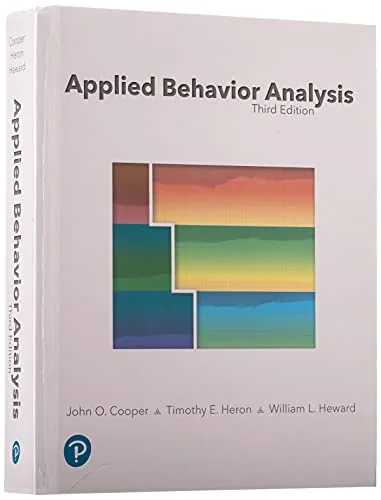
Applied Behavior Analysis, 3rd Edition examines behavioral principles, experimental methods, assessment, and intervention procedures. Cooper, Heron, and Heward connect philosophical foundations with reinforcement, stimulus control, teaching methods, and evaluation. Graduate students in behavior analysis encounter examples, graphs, and discussion questions that place procedures within research and ethical contexts.
Inside this title
Philosophical foundations and experimental methods of applied behavior analysis
Current listed price $33.99Regular price $86.00Digital ebook
Cooper, Heron, and Heward explain applied behavior analysis through its philosophical assumptions and experimental foundations. The text moves from principles such as reinforcement, punishment, and extinction to methods for assessing behavior and selecting interventions. Ethical considerations accompany the discussion of procedures that change behavior.
Teaching strategies include shaping, chaining, and discrete-trial training, while other sections examine differential reinforcement, antecedent interventions, stimulus control, and generalization. Single-subject research designs provide methods for evaluating effects. Graphs, examples, and discussion questions connect concepts with their application. This third edition is suited to graduate study and structured review of the relationships among measurement, analysis, teaching, and intervention.
Study guide included
Inside Applied Behavior Analysis, 3rd Edition.
A graduate-level foundation in behavioral principles, measurement, single-case design and intervention, organized around socially important change. Cooper, Heron and Heward connect philosophy and research methods to reinforcement, stimulus control, teaching and function-based support, preparing behavior analysts to justify every decision with observable evidence.
The text opens with the characteristics and dimensions of applied behavior analysis, then builds measurement and evaluation tools before turning to consequences, antecedents and teaching procedures. Later sections cover functional assessment, intervention selection, generalization, maintenance and professional ethics. Examples, graphs and discussion questions keep procedures tied to research and context, so readers learn to move from a worthwhile goal to evidence about how and why behavior changed. Each procedure is paired with the conditions under which it can be trusted.
Defining a socially useful goal
A target should matter to the learner and to those affected, not merely be easy to count. The seven dimensions tie that practical aim to observable behavior, systematic concepts, replicable procedures and demonstrated effects. An operational definition then states which actions qualify, where a response begins and ends, and what does not count, so a second observer can apply it and compare records before conclusions are drawn.
Choose goals that change daily participation
The seven dimensions anchor applied work
Operational definitions state boundaries
Have a second observer test the definition
Parts 1–2 · Chs. 1–3
Measurement and dependable records
The measure must match the question: rate for repeated events across unequal sessions, duration when time occupied matters, latency when delay is the issue, and permanent products when the outcome persists. Interval recording is practical but its rule can systematically over- or understate behavior. Agreement and accuracy are separate checks, because two observers can share the same flawed definition and still agree.
Match rate, duration or latency to the question
Interval rules can bias estimates
Check accuracy apart from agreement
Recalibrate when definitions drift
Part 2 · Chs. 4–5
Evaluating a functional relation
Single-case designs rely on repeated observation and planned comparison. Graphs are read by phase for level, trend and variability, then for speed of change, overlap and replication across comparable phases. Reversal designs withdraw and reintroduce a condition; multiple baselines stagger introduction across targets, people or settings; changing criteria test whether performance tracks successive goals. Each design depends on prediction and an opportunity to replicate.
Read graphs by phase for level and trend
Note overlap and speed of change
Match design to whether withdrawal is suitable
Replication strengthens a causal claim
Part 3 · Chs. 6–10
Consequences, antecedents and teaching
Reinforcement is defined by a later increase in responding and punishment by a decrease, with positive and negative naming addition or removal. A preferred activity is only a candidate reinforcer until its effect is shown. Schedules specify which responses earn consequences and motivating operations alter how valuable a consequence is now. Prompting, fading, shaping and chaining then build new response forms or longer sequences.
Define consequences by their observed effect
Test a reinforcer rather than assuming it
Schedules shape rate and persistence
Match prompting, shaping or chaining to the need
Parts 4–8 · Chs. 11–23
Assessing function and choosing support
Interviews identify relevant situations and direct observation records what precedes and follows a response, while experimental functional analysis, when appropriate and supervised, tests suspected relations by arranging conditions. A common sequence alone does not prove which consequence maintains behavior. A replacement should give the learner an efficient way to reach the same outcome, and antecedent changes can remove barriers before they arise.
Observation documents antecedents and consequences
Functional analysis tests suspected relations
A replacement must compete with the old response
Adjust antecedents to reduce barriers
Parts 9–10 · Chs. 24–27
Generalization, maintenance and ethics
Transfer has to be planned: relevant people, materials and settings enter instruction, or transfer is probed deliberately afterward. Natural cues and consequences help a skill persist as teaching supports fade, and monitoring across contexts shows whether it is used when useful. Ethical reasoning runs through target selection, consent, data handling and evaluation, and feedback from the learner and stakeholders belongs beside graphs of magnitude and stability.
Build transfer into instruction or probe for it
Natural consequences sustain maintenance
Monitor use across settings
Seek social validity alongside outcome data
Parts 11–13 · Chs. 28–31
Chapter and section map
Basic Concepts and PrinciplesCh. 2 · p. 25
Measuring BehaviorCh. 4 · p. 73
Multiple Baseline and Changing Criterion DesignsCh. 9 · p. 193
Positive ReinforcementCh. 11 · p. 252
Stimulus ControlCh. 17 · p. 395
Functional Behavior AssessmentCh. 27 · p. 628
Generalization and MaintenanceCh. 30 · p. 714
Ethical and Professional ResponsibilitiesCh. 31 · p. 758
Key takeaways
Define behavior observably and choose a measurement unit that answers the learner's real question.
Compare phases and replicate an effect before crediting a procedure for the change.
Plan generalization with natural cues, then check maintenance and transfer directly afterward.
Graduate students in behavior analysis and special education, and practitioners preparing for certification who want a rigorous, example-driven treatment of principles, measurement and procedures for clinical practice.
Topics covered
applied behavior analysis
single-case design
behavior measurement
positive reinforcement
stimulus control
functional behavior assessment
generalization and maintenance
professional ethics
Questions about this ebook.
Edition, audience, and study-guide details at a glance.
What is Applied Behavior Analysis, 3rd Edition about?
Applied Behavior Analysis, 3rd Edition examines behavioral principles, experimental methods, assessment, and intervention procedures. Cooper, Heron, and Heward connect philosophical foundations with reinforcement, stimulus control, teaching methods, and evaluation. Graduate students in behavior analysis encounter examples, graphs, and discussion questions that place procedures within research and ethical contexts.
Which edition of Applied Behavior Analysis, 3rd Edition is this?
This listing is for the 3rd edition. Check the title, ISBN, and book details above before ordering, especially if your course or reading list names a specific edition.
Who is Applied Behavior Analysis, 3rd Edition for?
Graduate students in behavior analysis and special education, and practitioners preparing for certification who want a rigorous, example-driven treatment of principles, measurement and procedures for clinical practice.
Does this page include a study guide?
Yes. This page includes an original study guide with six thematic sections, key takeaways, and a chapter and section map for structured reading.