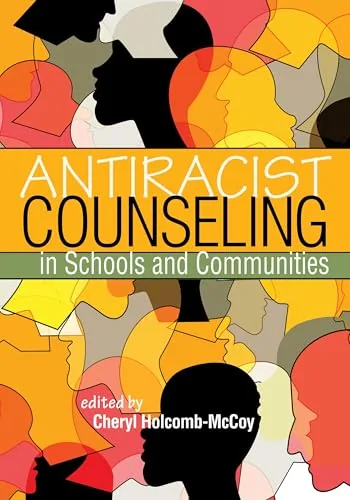
Antiracist Counseling in Schools and Communities examines racism within education and community mental health services. Cheryl Holcomb-McCoy connects multicultural counseling and social justice concepts with assessment, intervention, advocacy, and leadership, offering school counselors, community practitioners, and counselor educators a framework for examining institutional practices and their own professional decisions.
Inside this title
Antiracist approaches to school and community counseling settings
Current listed price $25.00Regular price $60.00Digital ebook
Counseling takes place within systems whose policies can shape access to support, disciplinary outcomes, and experiences of belonging. This book considers how counselors can identify racism within those systems and examine the assumptions that inform their own work with students, families, and communities.
Coverage extends from individual and group counseling to school-wide programming, policy review, and alliances with community organizations. Assessment, placement decisions, and advocacy provide concrete settings for considering antiracist action. School counselors, clinical supervisors, graduate students, and community mental health practitioners can use the text to connect reflection on power and identity with the everyday responsibilities of counseling practice.
Study guide included
Inside Antiracist Counseling in Schools and Communities.
Counseling happens inside institutions, and institutions distribute opportunity unevenly. This guide follows Holcomb-McCoy's framework from systemic racism and counselor self-examination through assessment, placement, individual and group work, school-wide programming, policy review, family partnerships, and advocacy, showing where antiracist practice meets everyday professional decisions.
Holcomb-McCoy places counseling inside institutional life. Schools and community agencies make decisions about assessment, placement, discipline, and access, and those decisions can reproduce racial inequity even when individual practitioners mean well. The book therefore moves between self-examination and system examination. It considers individual and group counseling, school-wide programming, policy review, and alliances with families and community organizations. Advocacy and leadership are treated as parts of the counselor's role rather than optional extras. The result is a framework that connects reflection on power and identity to the concrete responsibilities practitioners already carry.
Racism as an institutional pattern
Racism is treated as a feature of institutional practice, not only of individual attitudes. Policies, routines, and resource decisions can produce unequal outcomes regardless of intent. The book asks counselors to look at those patterns in the settings where they work and to see their own role within them.
Racism operates through routines and policies
Outcomes can be unequal without intent
Counselors are positioned inside those systems
Topic 1
Counselor self-examination
The text asks practitioners to examine the assumptions they bring to students, families, and communities. Identity and power shape what a counselor notices and how a concern is framed. Reflection is presented as a continuing professional discipline rather than a one-time exercise.
Assumptions shape what is noticed
Identity and power affect framing
Reflection is ongoing professional work
Topic 2
Assessment, placement, and discipline
Assessment and placement decisions sort students into opportunities, and disciplinary practice can remove them from support. The book examines these moments for racial patterns and for the assumptions behind them. Counselors are positioned as participants in those decisions, with scope to question and to advocate.
Placement decisions allocate opportunity
Discipline can remove access to support
Counselors can question and advocate
Topics 3-4
Individual and group counseling practice
Individual and group counseling are considered alongside the systems in which they occur. The text connects therapeutic work with the student's or client's experience of school and community, and it asks how practice can avoid reproducing the inequities it aims to address. Technique is discussed in relation to context.
Therapy is situated in school and community life
Practice can reproduce or challenge inequity
Technique is read in context
Topic 5
School-wide programming and policy review
School-wide programming and policy review extend antiracist work beyond the counseling office. The book treats curriculum, climate, and institutional rules as sites where counselors can contribute, using their vantage point on how students experience the system. The emphasis is on changing conditions rather than fixing individuals.
Programming reaches beyond individual cases
Climate and rules are sites of intervention
The focus is conditions, not deficits
Topic 6
Family partnerships and advocacy
Families and community organizations are presented as partners rather than as recipients of services. The text discusses alliances, communication, and advocacy as ways of extending the counselor's reach and accountability. Leadership is framed as part of the role, exercised through influence on decisions and practices.
Families are partners, not recipients
Community alliances extend the counselor's reach
Leadership works through influence on decisions
Topics 7-8
Topic map
Racism in schools and community servicesTopic 1
Counselor self-examination and assumptionsTopic 2
Assessment and placement decisionsTopic 3
Discipline and access to supportTopic 4
Individual and group counselingTopic 5
School-wide programming and policy reviewTopic 6
Family and community partnershipsTopic 7
Advocacy and leadershipTopic 8
Key takeaways
Racism operates through institutional routines as well as individual attitudes.
Assessment and discipline are decision points where inequity can be reinforced or challenged.
Partnerships and advocacy extend the counselor's role beyond the office.
School counselors, community mental health practitioners, clinical supervisors, and counselor educators working with multicultural and social justice frameworks.
Topics covered
antiracist counseling
school counseling
community mental health
multicultural counseling
social justice advocacy
assessment and placement
counselor leadership
educational equity
Questions about this ebook.
Edition, audience, and study-guide details at a glance.
What is Antiracist Counseling in Schools and Communities about?
Antiracist Counseling in Schools and Communities examines racism within education and community mental health services. Cheryl Holcomb-McCoy connects multicultural counseling and social justice concepts with assessment, intervention, advocacy, and leadership, offering school counselors, community practitioners, and counselor educators a framework for examining institutional practices and their own professional decisions.
Who is Antiracist Counseling in Schools and Communities for?
School counselors, community mental health practitioners, clinical supervisors, and counselor educators working with multicultural and social justice frameworks.
Does this page include a study guide?
Yes. This page includes an original study guide with six thematic sections, key takeaways, and a topic map for structured reading.