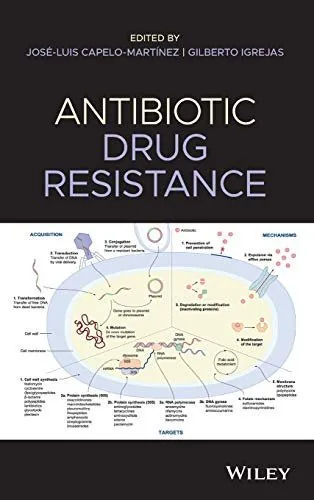
Cover of Antibiotic Drug Resistance, 1st Edition

Antibiotic Drug Resistance, 1st Edition

Edited by José-Luis Capelo-Martínez, Gilberto Igrejas

About this ebook

Antibiotic Drug Resistance examines bacterial resistance from molecular mechanisms to public health responses. Edited by José-Luis Capelo-Martínez and Gilberto Igrejas, this first-edition reference brings together microbiology, genetics, diagnostics, epidemiology, and therapeutic research for graduate students and professionals studying resistant pathogens and antimicrobial use across clinical and research settings.

Inside this title
  • Biochemical resistance mechanisms and movement of bacterial resistance genes
Current listed price $64.99Regular price $185.00Digital ebook
Buy now

Digital ebook. Checkout sends an order request.

Format
Digital ebook
ISBN
9781119282549
Last updated
2026-11-03

What this book covers.

Resistance is examined at several connected scales: biochemical changes within bacteria, the movement of resistance genes, and the spread of resistant organisms across populations. Chapters address enzymatic drug inactivation, altered targets, efflux, permeability, mobile genetic elements, and biofilms alongside major pathogen groups.

The volume also considers phenotypic and molecular diagnostic approaches, stewardship, surveillance, and policy. Research on antimicrobial peptides, bacteriophages, and combination therapies broadens the discussion beyond existing antibiotics. Its multidisciplinary scope suits microbiologists, pharmacologists, infectious disease researchers, and public health specialists, as well as graduate readers developing a framework for understanding resistance as both a laboratory problem and a population-level concern.

Study guide included

Inside Antibiotic Drug Resistance, 1st Edition.

This edited reference examines antibiotic resistance from molecular mechanism to public-health response. Chapters connect biochemistry, genetics, diagnostics, epidemiology, stewardship, and emerging therapeutic research. It is written for graduate students and professionals who need a framework for understanding resistant pathogens in both laboratory and population settings.

The guide follows the volume's movement across scales. It begins inside the bacterial cell, where enzymatic inactivation, altered targets, reduced permeability, and efflux reduce drug effectiveness. It then widens to gene transfer and the spread of resistant organisms through populations. Diagnostic approaches, biofilm behavior, and major pathogen groups receive separate treatment. Later themes turn to stewardship, surveillance, policy, and research into peptides, bacteriophages, and combination therapy. The organizing aim is to show resistance as a connected laboratory and public-health problem rather than a single mechanism.

Mechanisms inside the bacterial cell

Resistance can arise when bacteria alter a drug's target, destroy the compound enzymatically, pump it out, or keep it from entering. The volume treats these as distinct biochemical strategies with different implications. The theme gives readers a vocabulary for classifying resistance rather than treating it as a single phenomenon. It also shows why one drug may fail for several reasons.

  • Classify mechanisms by target, enzyme, efflux, or permeability
  • Distinguish intrinsic from acquired resistance
  • Connect mechanism to observed drug failure
Topic 1

Genes that move between bacteria

Resistance traits spread when genetic material travels among organisms. The volume examines mobile genetic elements and the processes that carry resistance determinants across strains and species. The theme shifts attention from a single cell to a population of genes. It explains why resistance can appear in places where a drug was not heavily used.

  • Identify mobile elements that carry resistance genes
  • Trace horizontal transfer across strains
  • Link gene movement to clinical spread
Topic 2

Pathogens, biofilms, and persistent infection

Specific pathogen groups present different resistance challenges, and biofilm growth adds another layer of protection. The volume connects organism biology with the difficulty of clearing infections. The theme asks readers to consider the setting in which resistance emerges, not just the mechanism. It prepares for the diagnostic and therapeutic discussions that follow.

  • Compare resistance patterns across pathogen groups
  • Explain how biofilms shield bacteria
  • Relate infection site to treatment difficulty
Topic 3

Detecting resistance in the laboratory

Phenotypic methods observe how an organism responds to a drug, while molecular methods look for known resistance determinants. The volume presents both as complementary rather than competing. The theme considers what each approach can and cannot establish. It connects laboratory results with the clinical decisions they are meant to inform.

  • Contrast phenotypic with molecular detection
  • Recognize the limits of each method
  • Connect lab findings to clinical choices
Topic 4

Stewardship, surveillance, and policy

Individual prescribing decisions and population-level monitoring both shape resistance. The volume discusses stewardship as a way to reduce selective pressure while surveillance tracks emerging patterns. Policy connects evidence with regulation and practice. The theme treats these as coordinated responses rather than separate administrative topics or isolated initiatives.

  • Explain how stewardship reduces selective pressure
  • Describe what surveillance systems monitor
  • Connect evidence to policy and practice
Topic 5

Alternatives and combination strategies

Research into antimicrobial peptides, bacteriophages, and combined drug regimens points beyond existing antibiotics. The volume presents these as active areas of investigation rather than settled replacements. The theme asks what each approach offers and what remains unresolved. It closes by framing resistance as a problem that requires both new tools and better use of old ones.

  • Describe the promise of peptides and phages
  • Explain why combination therapy is studied
  • Separate research promise from established practice
Topic 6

Topic map

  • Biochemical Resistance MechanismsTopic 1
  • Mobile Genetic Elements and Gene TransferTopic 2
  • Resistant Pathogens and BiofilmsTopic 3
  • Phenotypic and Molecular DiagnosticsTopic 4
  • Stewardship and SurveillanceTopic 5
  • Alternative Antimicrobial StrategiesTopic 6
  • Policy and Population ResponseTopic 7

Key takeaways

  • Resistance is best understood as a set of mechanisms that operate from the cell to the population.
  • Diagnostic choice depends on whether the question is about behavior or about a known gene.
  • Stewardship and surveillance address selective pressure that individual treatment decisions cannot see.

Graduate students and professionals in microbiology, pharmacology, infectious disease research, and public health who study resistant pathogens and antimicrobial use across clinical and laboratory settings.

Topics covered

  • antibiotic resistance
  • resistance mechanisms
  • mobile genetic elements
  • bacterial biofilms
  • antimicrobial stewardship
  • molecular diagnostics
  • bacteriophage therapy
  • antimicrobial peptides
  • resistance surveillance

Questions about this ebook.

Edition, audience, and study-guide details at a glance.

What is Antibiotic Drug Resistance, 1st Edition about?

Antibiotic Drug Resistance examines bacterial resistance from molecular mechanisms to public health responses. Edited by José-Luis Capelo-Martínez and Gilberto Igrejas, this first-edition reference brings together microbiology, genetics, diagnostics, epidemiology, and therapeutic research for graduate students and professionals studying resistant pathogens and antimicrobial use across clinical and research settings.

Which edition of Antibiotic Drug Resistance, 1st Edition is this?

This listing is for the 1st edition. Check the title, ISBN, and book details above before ordering, especially if your course or reading list names a specific edition.

Who is Antibiotic Drug Resistance, 1st Edition for?

Graduate students and professionals in microbiology, pharmacology, infectious disease research, and public health who study resistant pathogens and antimicrobial use across clinical and laboratory settings.

Does this page include a study guide?

Yes. This page includes an original study guide with six thematic sections, key takeaways, and a topic map for structured reading.

Keep your curiosity going.

More books from this subject area.

More medicine & health sciences ebooks

Enter your name and email to open a WhatsApp message with your details.