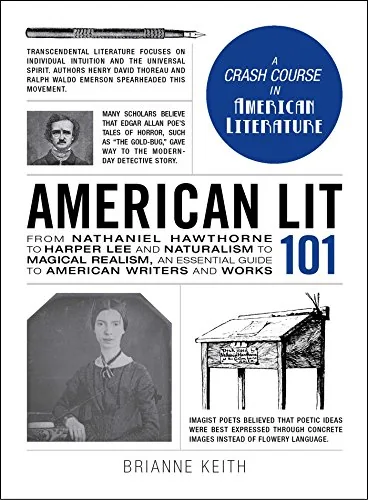
American Lit 101: From Nathaniel Hawthorne to Harper Lee
By Brianne Keith
About this ebook
American Lit 101 introduces American writers and literary movements through author profiles and discussions of major works. Brianne Keith follows the subject from colonial writing through Romanticism, Realism, Modernism, and later literature. Students and general readers can explore how books reflect the cultural and historical settings in which they appeared.
Inside this title
Author profiles placed within American cultural and historical contexts
Current listed price $1.99Regular price $5.00Digital ebook
Individual writers provide the entry points into this survey of American literature. Profiles place authors such as Edgar Allan Poe, Willa Cather, F. Scott Fitzgerald, and Toni Morrison within their periods, explaining the ideas and literary experiments associated with their work. The movement-based context helps readers relate authors to a wider literary history.
Discussions of works including The Scarlet Letter, The Adventures of Huckleberry Finn, The Great Gatsby, and To Kill a Mockingbird connect recognizable titles with the concerns they explore. The guide suits readers preparing for introductory literature study, revisiting familiar writers, or choosing further reading across different periods of the American tradition.
Study guide included
Inside American Lit 101: From Nathaniel Hawthorne to Harper Lee.
Brianne Keith builds a survey of American writing around the people who made it, pairing author profiles with the movements they belonged to. The result is a route through several centuries of literature for readers who want orientation before close reading.
The book proceeds by author and by period at once. Colonial writing gives way to Romanticism, then Realism, Modernism, and the literature that followed, with each movement described through the ideas and experiments that defined it. Profiles of figures such as Poe, Cather, Fitzgerald, and Morrison sit inside that frame, and discussions of The Scarlet Letter, Huckleberry Finn, The Great Gatsby, and To Kill a Mockingbird connect familiar titles to the concerns they raise. Because entries can be read alone, the guide works as a reference for a specific writer or as a sequence that shows how one generation answered the last.
Author as entry point
Each chapter begins with a writer rather than an abstract movement. Biography, historical setting, and the work are held together, so a reader meets a body of writing through the circumstances that shaped it. This choice makes the survey approachable without reducing literature to biography; the context explains the work without explaining it away.
Writers anchor each period
Context informs without replacing reading
Entries work alone or in sequence
Topic 5
From colonial writing onward
Early American writing is presented as a foundation rather than a prelude. The text shows how religious, political, and personal purposes shaped what was written before a national literature was imagined. Reading these works on their own terms matters, because later writers defined themselves partly against them.
Early writing had its own purposes
National literature emerged gradually
Later writers reacted to these roots
Topic 1
Romanticism and the inner life
The Romantic period shifts attention toward imagination, emotion, and the individual. The book describes how writers of this era treated nature and selfhood, and how their emphasis differed from what came before. Recognising the shift helps a reader see why a story or poem of the period sounds the way it does.
Imagination and emotion gain emphasis
Nature becomes a central subject
The individual moves to the foreground
Topic 2
Realism and close attention
Realism turns toward ordinary life, social detail, and accurate depiction. The text explains the impulse to render how people actually lived, and how that ambition changed narrative style. The contrast with Romantic writing is made explicit, so readers can see the argument each movement was having with its predecessor.
Ordinary life becomes worthy subject
Concrete detail replaces idealisation
Style changes with the ambition
Topic 3
Modernism and formal experiment
Modernist writing is described through its break with inherited forms. Fragmentation, new narrative techniques, and a changed sense of certainty appear as responses to a transformed world. The book treats experiment as purposeful rather than arbitrary, which helps a reader approach difficult texts with a question instead of a complaint.
Inherited forms come under pressure
Technique becomes plainly visible
Difficulty carries a purpose
Topic 4
Titles that carry the tradition
Discussions of well-known works give the survey its landmarks. The Scarlet Letter, Huckleberry Finn, The Great Gatsby, and To Kill a Mockingbird are treated as texts with specific concerns, not just famous names. Connecting each to its period shows how a book can be both of its moment and readable long after it.
Landmark works anchor the survey
Each title answers its period
Fame and meaning are separate questions
Topic 6
Topic map
Colonial and Early American WritingTopic 1
RomanticismTopic 2
Realism and Social ObservationTopic 3
Modernism and Formal ExperimentTopic 4
Major Authors in ProfileTopic 5
Landmark Works in ContextTopic 6
Reading Beyond the SurveyTopic 7
Key takeaways
Movements are easier to remember when attached to a writer whose work shows the change in practice.
A familiar title becomes more interesting once you can name the question its period was asking.
The survey is a starting map, not a verdict; it points toward reading rather than replacing it.
Students preparing for introductory literature courses, general readers revisiting familiar authors, and anyone who wants orientation while choosing what to read next across the American literary tradition.
Topics covered
American literature
literary movements
author profiles
American Romanticism
literary realism
literary modernism
study guide
Questions about this ebook.
Edition, audience, and study-guide details at a glance.
What is American Lit 101: From Nathaniel Hawthorne to Harper Lee about?
American Lit 101 introduces American writers and literary movements through author profiles and discussions of major works. Brianne Keith follows the subject from colonial writing through Romanticism, Realism, Modernism, and later literature. Students and general readers can explore how books reflect the cultural and historical settings in which they appeared.
Who is American Lit 101: From Nathaniel Hawthorne to Harper Lee for?
Students preparing for introductory literature courses, general readers revisiting familiar authors, and anyone who wants orientation while choosing what to read next across the American literary tradition.
Does this page include a study guide?
Yes. This page includes an original study guide with six thematic sections, key takeaways, and a topic map for structured reading.