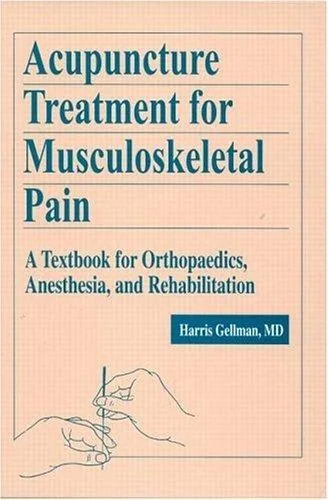
Acupuncture Treatment for Musculoskeletal Pain: Textbook for Orthopaedics, Anesthesia and Rehabilitation
By Harris Gellman
About this ebook
Acupuncture Treatment for Musculoskeletal Pain presents acupuncture concepts in relation to orthopaedic, anesthesia, and rehabilitation practice. Harris Gellman's 2002 textbook addresses Western-trained clinicians, combining traditional diagnostic ideas with musculoskeletal assessment, point selection, needling techniques, and discussions of pain conditions affecting the spine, joints, and soft tissues.
Inside this title
Traditional acupuncture concepts related to musculoskeletal clinical assessment
Current listed price $23.99Regular price $54.00Digital ebook
Gellman organizes acupuncture around the musculoskeletal problems encountered in orthopaedics and rehabilitation. The text introduces traditional concepts such as Qi, meridians, and Five Element theory before relating them to clinical assessment and the selection of treatment points.
Its condition-focused discussions include neck and low back pain, rotator cuff problems, epicondylitis, carpal tunnel syndrome, and knee osteoarthritis. Case studies illustrate how the book brings acupuncture into conversation with conventional examination, rehabilitation exercises, and other treatments. Safety considerations, contraindications, and adverse events are also addressed. This 2002 textbook is intended for clinicians studying the conceptual and clinical approaches presented in an earlier account of musculoskeletal acupuncture.
Study guide included
Inside Acupuncture Treatment for Musculoskeletal Pain: Textbook for Orthopaedics, Anesthesia and Rehabilitation.
Gellman writes for clinicians trained in Western medicine who want acupuncture placed beside orthopaedic and rehabilitation practice. Traditional ideas about Qi, meridians and the Five Elements are introduced, then tied to musculoskeletal examination, point selection and needling for pain in the spine, joints and soft tissues.
The book is organized around clinical problems rather than around a defence of acupuncture theory. An opening account of traditional concepts gives way to assessment: what a clinician examines, how a presentation is read, and where acupuncture might fit among other treatments. Specific discussions cover neck and low back pain, rotator cuff problems, epicondylitis, carpal tunnel syndrome and knee osteoarthritis. Point selection and needling technique are presented together with safety material on contraindications and adverse events. Case studies carry the approach into realistic presentations, and rehabilitation exercises and conventional care sit alongside the acupuncture decisions rather than after them. The 2002 text assumes a reader who already knows musculoskeletal medicine.
Traditional concepts for a clinical audience
Qi, meridians and Five Element theory are introduced because the book's clinical vocabulary depends on them, not as a separate belief system to be settled first. The presentation assumes readers who reason in orthopaedic and rehabilitation terms, and it explains the traditional categories in language such a reader can follow before any treatment is discussed.
Traditional terms are defined for readers without that background
The concepts are treated as the basis of clinical reasoning
Explanation precedes any recommendation
Topic 1
Assessment before treatment
The text places examination ahead of needling. A clinician is asked to establish what the musculoskeletal problem is, which structures are involved and how the presentation behaves, before deciding whether acupuncture belongs in the plan. Assessment is where the two traditions are brought into contact rather than kept apart.
Musculoskeletal examination comes first
The presentation is interpreted before treatment is chosen
Acupuncture is placed within a broader clinical plan
Topic 2
Point selection and needling technique
Selection of points is discussed as a decision that follows from the assessment, with technique treated as a practical skill rather than a ritual. The book covers how points are chosen for a given presentation and how needling is carried out, keeping the clinical purpose of each step visible throughout.
Point choice follows from the clinical picture
Needling technique is described as a practical procedure
Each step is tied to a treatment aim
Topic 3
Regional pain conditions
Condition-focused sections move through the problems most often seen in orthopaedic and rehabilitation settings: neck and low back pain, rotator cuff lesions, epicondylitis, carpal tunnel syndrome and knee osteoarthritis. Each is handled as a distinct presentation with its own assessment and treatment considerations, rather than as an illustration of a single general rule.
Spinal, shoulder, elbow, wrist and knee problems are treated separately
Each condition gets its own assessment and treatment discussion
The emphasis stays on common orthopaedic presentations
Topics 4-6
Safety, contraindications and adverse events
Safety material is integrated into the clinical discussion rather than appended as a disclaimer. Contraindications and the possibility of adverse events are presented as part of deciding whether and how to needle, which keeps risk in the same conversation as benefit and technique.
Contraindications belong to treatment decisions
Adverse events are addressed directly
Risk is discussed alongside technique
Topic 7
Cases and combined care
Case studies show the approach applied to realistic presentations, where acupuncture is weighed against and combined with rehabilitation exercises and conventional treatment. The cases illustrate the book's underlying position: acupuncture is one component of musculoskeletal care, and its use has to be justified within the whole plan.
Cases demonstrate reasoning across a full presentation
Rehabilitation and conventional care remain in view
Acupuncture is presented as one part of management
Topic 7
Topic map
Traditional Concepts and TerminologyTopic 1
Musculoskeletal AssessmentTopic 2
Point Selection and Needling TechniqueTopic 3
Spinal PainTopic 4
Shoulder, Elbow and Wrist ConditionsTopic 5
Knee Osteoarthritis and Soft Tissue PainTopic 6
Safety and Case-Based IntegrationTopic 7
Key takeaways
The book addresses clinicians who already know musculoskeletal medicine, so assessment is never skipped in favour of technique.
Traditional concepts are explained in order to support clinical decisions, not as an independent subject.
Safety and contraindications are treated as part of choosing treatment, not as a closing warning.
Orthopaedic, anesthesia and rehabilitation clinicians, plus practitioners and students who want acupuncture presented within conventional musculoskeletal assessment and care.
Topics covered
acupuncture musculoskeletal pain
orthopaedic acupuncture textbook
rehabilitation acupuncture
traditional acupuncture concepts
point selection and needling
neck and low back pain
carpal tunnel syndrome
knee osteoarthritis
acupuncture safety and contraindications
Questions about this ebook.
Edition, audience, and study-guide details at a glance.
What is Acupuncture Treatment for Musculoskeletal Pain: Textbook for Orthopaedics, Anesthesia and Rehabilitation about?
Acupuncture Treatment for Musculoskeletal Pain presents acupuncture concepts in relation to orthopaedic, anesthesia, and rehabilitation practice. Harris Gellman's 2002 textbook addresses Western-trained clinicians, combining traditional diagnostic ideas with musculoskeletal assessment, point selection, needling techniques, and discussions of pain conditions affecting the spine, joints, and soft tissues.
Who is Acupuncture Treatment for Musculoskeletal Pain: Textbook for Orthopaedics, Anesthesia and Rehabilitation for?
Orthopaedic, anesthesia and rehabilitation clinicians, plus practitioners and students who want acupuncture presented within conventional musculoskeletal assessment and care.
Does this page include a study guide?
Yes. This page includes an original study guide with six thematic sections, key takeaways, and a topic map for structured reading.